FOR IMMEDIATE RELEASE
June 19, 2026
Contact:
Michael K. Frisby
mike@Frisbyassociates.com/202-625-4328
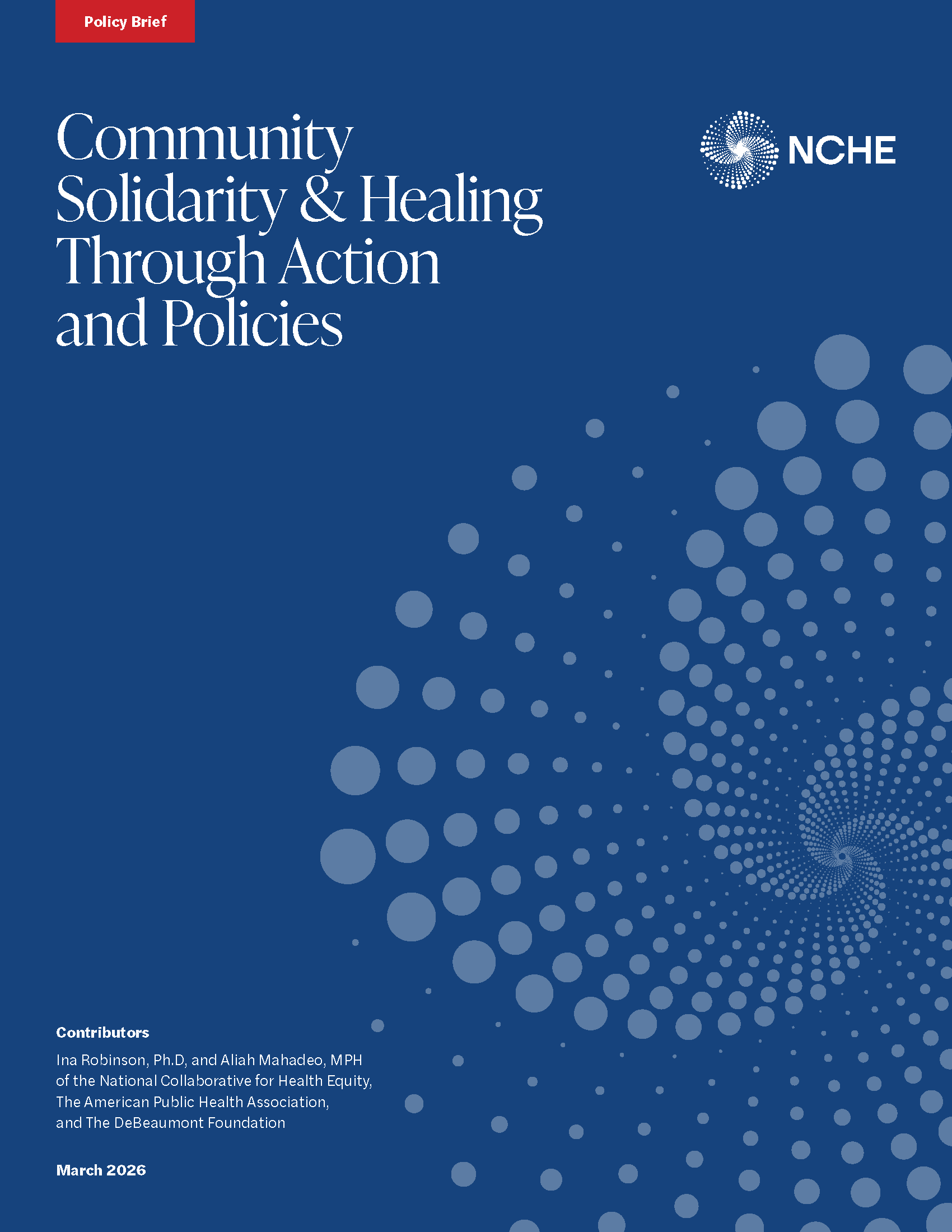
A new report, Community Solidarity & Healing Through Action and Policies, celebrates progress on equity even as federal support for diversity and inclusion declines
WASHINGTON, D.C. — The National Collaborative for Health Equity (NCHE) today released Community Solidarity & Healing Through Action and Policies, a comprehensive policy paper documenting the creative and persistent work that leaders across the United States have carried out over the past five years to advance racial healing and health equity.
The paper expands the foundational Healing Through Policy briefs published in 2021, similarly organizing its findings around the five pillars of the Truth, Racial Healing, and Transformation (TRHT) strategic framework: Narrative Change; Racial Healing & Relationship Building; Separation; Law; and Economy.
Authored by NCHE’s Ina Robinson, Ph.D., and Aliah Mahadeo, MPH, the new work was produced in partnership with the American Public Health Association (APHA). It arrives at a pivotal moment, as shifts in federal policy and reduced access to public datasets have created new challenges for organizations, local governments, non-profits, and communities pursuing equity.
“We have expanded on the original Healing Through Policy paper,” said Dr. Gail C. Christopher, NCHE’s executive director. “There have been many changes across politics, government, public health, and health equity. It was important to expand on the foundational work and to remind communities that, despite the aggressive attacks on equity and justice, healing work continues. Narrative change remains the overriding pillar of TRHT. It’s critically important that we identify the false narratives and galvanize movement toward expanding community and health equity and fairness for all.”
Since the founding of America, policies, practices, and laws have enforced a false hierarchy of human value based on race, with direct and lasting effects on the health of individuals and communities. The new paper celebrates promising policies and practices that center solidarity, equity, truth-telling, and community-led solutions. It also responds directly to the tumultuous political climate, noting that since January 2025, federal actions limiting diversity, equity, inclusion, and accessibility (DEIA) work have prompted widespread over-compliance among impacted state agencies, nonprofits, and private organizations, limiting their effectiveness.
Further, Dr. Christopher noted that the movement toward equality has historically faced stiff resistance, just as is the case today.
“This policy paper presents some of the resources that communities are using to combat the way that data and information have been weaponized against those seeking to expand community and health equity,” she said. “It’s important to remain not just hopeful, but inspired to continue the progress toward equity and fairness. This is not a sprint. It’s more than a marathon. It’s a continuous journey. Every major movement in our journey toward equity has been met with tremendous resistance, whether in the Reconstruction era or at the end of the Jim Crow era through the Civil Rights Movement. There’s always been resistance. Today is no different. What we are experiencing in terms of an assault on equity and diversity is a direct response to the progress that communities are making.”
The paper underscores the power of narrative change within the TRHT framework, arguing that it is rooted in the understanding that stories shape our shared beliefs about human value. Key findings show that as of 2025, more than 268 state and local leaders have declared racism a public health crisis or emergency, up from 200 in 2020 and 250 in 2022.
A 2025 survey of APHA members and other communications revealed that these declarations helped organizations build the internal capacity to continue equity work even in hostile environments. Many of these efforts, including racial equity impact assessments and health equity policy frameworks, did not depend on external funding.
The paper also highlights progress in disaggregating racial and ethnic data. In 2025, 13 states passed laws requiring the disaggregation of racial and ethnic data, helping communities identify needs often hidden by broad data categories. California, Illinois, and New York were among the states adopting more detailed standards, including new categories for Middle Eastern and North African residents. The report also offers guidance on safeguarding federal datasets, which have faced funding cuts and staffing reductions that threaten their reliability.
Across the country, cities and states have publicly acknowledged historical wrongs and paired those acknowledgments with action. In 2024, Chicago Mayor Brandon Johnson apologized for historical injustices committed against Black residents, and the city created a Black Reparations Task Force. California lawmakers passed legislation to atone for racism, and in 2025, the state returned ancestral lands to the Yurok Tribe. Illinois renewed $4.5 million for its Healing Illinois grant program, which supports organizations doing racial healing work.
The paper also highlights the role of restorative justice in schools. At Fremont High School in Oakland, California, years of restorative justice practice produced a 20% enrollment increase, a tripling in the number of students qualifying for college admission, and a stronger, closer community. Programs such as TRHT Places and TRHT College Campus Centers continue to prepare the next generation of leaders to dismantle systemic racism, with NCHE collaborating with 15 TRHT Places and the American Association of Colleges & Universities partnering with 72 institutions.
Separation: Bringing Communities Together
Under the Separation pillar, the paper documents how zoning innovation, tenant protections, and equitable transit planning are reversing patterns that keep communities apart. Boston updated its inclusionary zoning plan to require more income-restricted housing and set aside units for households with housing choice vouchers. Cities, including Chicago and New York City, enacted “just cause” eviction protections to shield tenants from arbitrary or discriminatory evictions. At the same time, transit agencies in Boston and New York committed to building equity into their planning.
Law: Reimagining Safety and Justice
The Law pillar highlights significant reforms in public safety and criminal justice. All 50 states enacted some form of police reform between 2020 and 2024, and communities have invested in alternative response models. In Eugene, Oregon, the CAHOOTS civilian crisis response program responds to 20% of 911 calls and saves the city an estimated $2.2 million in officer wages each year. Denver’s Support Team Assisted Response program achieved a 34% decrease in crime in participating neighborhoods. States including Oklahoma, New Mexico, and Virginia moved to eliminate criminal justice fees and create affordable payment plans, recognizing how such fees trap people in cycles of debt. Meanwhile, 28 U.S. cities are now Certified Welcoming, reflecting a commitment to immigrant inclusion even amid a difficult political environment.
Economy: Building Wealth and Repairing Harm
The paper also documents economic progress. More than 20 states raised their minimum wage in 2025, and Maine proposed replacing its minimum wage with a livable wage scale. Cities and states, including Saint Paul, Minnesota, Austin, Texas, and Illinois, launched Universal Basic Income pilot programs, with Saint Paul reporting increased employment, improved mental health, and safer housing. Reparations efforts gained ground in several communities. Portland, Oregon, agreed to pay $8.5 million in settlements to Black families displaced by urban renewal projects. In Tulsa, Oklahoma, officials announced a commission to recommend reparations for those affected by the 1921 Tulsa Race Massacre. Maryland lawmakers approved a measure to study reparations for slavery. And participatory budgeting in cities like Boston and Albuquerque gives residents a direct voice in how public funds are spent.
The paper closes with recommended action strategies, including conducting community surveys to reveal shared values. NCHE’s 2025 Heart of America poll found broad consensus on equity: 78% of respondents believe promoting diversity is crucial to addressing the historical impact of racism, and 83% feel educating children about the history of race and racism is important for racial healing.
“The pursuit of racial equity and solidarity is both a present imperative and a long-term endeavor,” the report concludes. The authors hope the paper will inspire leaders to sustain the momentum of the past five years by rewriting local ordinances, protecting data infrastructure, cultivating spaces for healing, investing in economic redress, or engaging other measures.
The full paper, Community Solidarity & Healing Through Action and Policies, is available HERE.
About the National Collaborative for Health Equity
Founded in 2014, NCHE was established to promote health equity through action, leadership, inclusion, and collaboration. We work to create environments that foster the best possible health outcomes for all populations, regardless of race, ethnicity, socioeconomic status, or nativity. NCHE also works to improve conditions for health and well-being, including housing, education, income and wealth, and the physical and social environment. Further, we must address historical and contemporary structural, institutional, and interpersonal racism, which fuels inequities in our society.