By Dr. Gail C. Christopher
As America turns 250, we keep asking the same question: What kind of country will we hand to the next generation?
But reality is: The next generation isn’t waiting to inherit America. They already live here, dealing with the daily challenges that we all face. Perhaps the more urgent question is what kind of country they believe they are living in right now.
The answer, maybe surprising to many of us, depends on how old you are.
This year, the National Collaborative for Health Equity (NCHE) conducted its 4th Annual Heart of America Survey. It surveyed 1,322 Americans about the forces that hold a nation together or pull it apart: unity, belonging, race, democracy and the relentless pressures of daily life. When we placed the answers of adults ages 18 to 34 beside those of Americans 65 and older, we found something that should both comfort and unsettle us.
Young and old Americans want largely the same things for this country. They share the same hopes.
Yet, they do not share the same realities and perspectives.
I learned from years working in health equity that people’s outcomes are shaped by the environment and conditions they live in. Good intentions don’t lower blood pressure, prevent heart attacks, improve mental health, reduce the risk of diabetes, or alleviate digestive woes. Shared values don’t pay the rent or put food on the table. The same is true of a nation’s civic health. A country can agree on its dreams and still fracture under the weight of unequal realities.
If we want to heal our divisions, we need to do more than just know what Americans think. We need to better understand the burdens they carry and embark on a path to address those problems and ease divisions.
Common ground is wider than we think
Start with what unites us, because there is more of it than our politics would suggest.
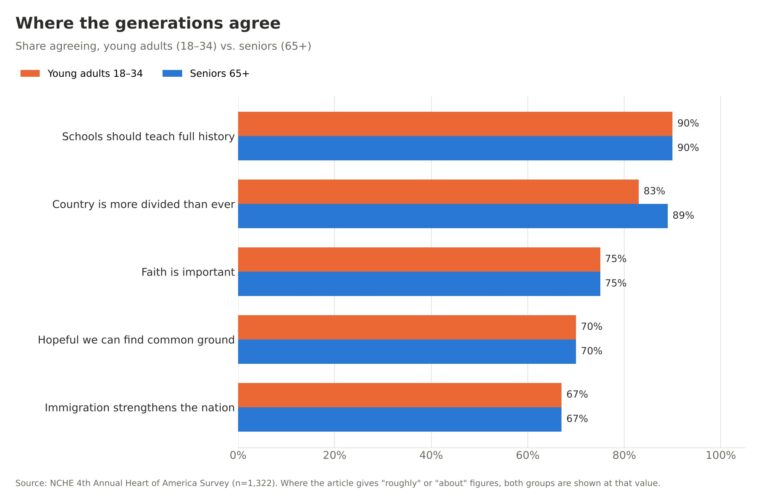
Americans of every age agree the country is deeply divided. Eighty-three percent of young adults and 89 percent of seniors say we are more divided than ever. Yet roughly seven in ten in both groups remain hopeful that we can work through our differences and find lasting common ground.
Both generations are hungry for a different kind of leadership. More than eight in ten young and old alike want leaders who can see past labels and political tricks, and large majorities would support a leader who aims to unite the country even when they disagree with some of that leader’s positions.
On the questions that dominate our culture wars, the generations are remarkably close. Faith is important to three in four Americans regardless of age. Nearly identical shares, about 53 percent, believe all Americans have the same chance at a good life, while 47 percent see inequality as systemic. Roughly two-thirds of both groups say immigration strengthens the nation. And about nine in ten young and old agree that schools should teach the full history of America, including slavery and racism.
On those ideological questions, party divides Americans far more than age does. That is an important corrective to the popular story of a simple war between generations.
Where the generations part ways
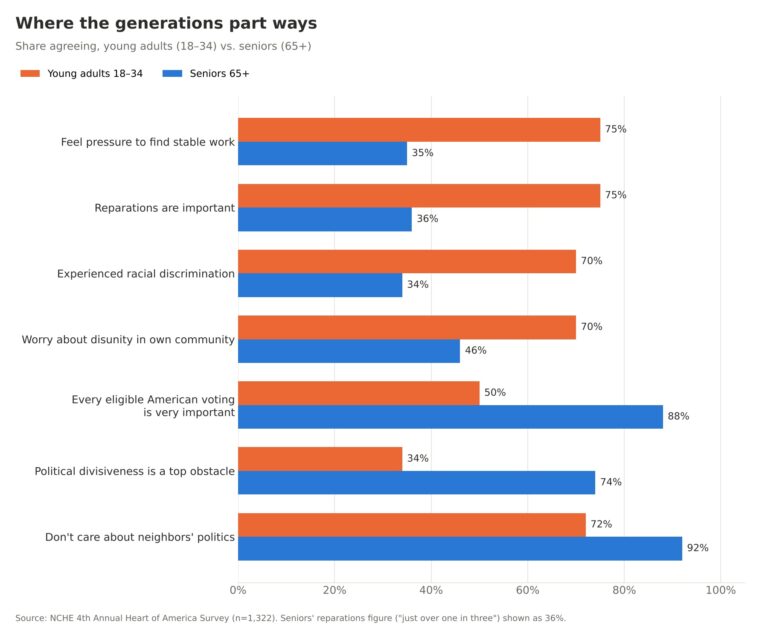
Surprisingly, the divides that do exist are not rooted in ideology. They are about lived experience, about the machinery of democracy, and about what it will take to repair the harms of the past. Some of the gaps reach 40 percentage points:
- Discrimination is a daily reality for the young. Seventy percent of young adults say they have personally experienced discrimination because of their race, compared with 34 percent of seniors. The gaps are just as wide for discrimination based on religion, gender, and sexuality. Three in ten young adults say they experience racism or discrimination frequently; fewer than one in ten seniors do. Part of this reflects diversity: only 30 percent of our young respondents are white, versus 82 percent of seniors. But that is the point. Young people are encountering America’s old wounds firsthand.
- Older Americans guard the vote. Eighty-eight percent of seniors say it is very important that every eligible American can vote. Only half of young adults agree, and 17 percent of Gen Z say it is not important. Seniors are also far more likely to believe that voting maps are drawn to keep parties in power.
- They diagnose different illnesses. Asked to name the biggest obstacles to an America where everyone shares equally in opportunity, 74 percent of seniors chose political divisiveness. Only 34 percent of young adults did. Younger Americans instead point to racism, gender discrimination, police brutality and over-incarceration. Older Americans see a broken politics. Younger Americans see broken systems.
- They differ most on repair. Three in four young adults say reparations for the descendants of enslaved Americans are important, compared with just over one in three seniors, the single largest gap in our survey. Seniors favor relationship building and working together toward common goals as the path to racial healing.
- The pressures of daily life fall unevenly. Every generation feels the weight of grocery and health care costs. But young adults are twice as likely as seniors to feel the pressure to find stable, well-paying work (75 percent versus 35 percent), and more than twice as likely to feel squeezed by childcare costs. These are the social determinants of health in plain view.
“Young” is not one group
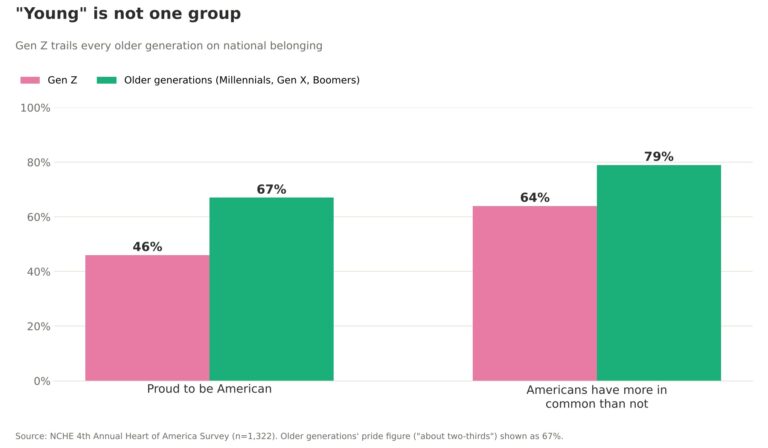
One of our most striking findings is that the youngest Americans and the generation just ahead of them often look less alike than Millennials and Baby Boomers do.
Millennials, now roughly in their 30s and 40s, are the most optimistic generation in our survey. Seventy-eight percent are hopeful that Americans can find common ground, 70 percent are confident we will overcome our divisions, and half believe America is living up to its ideals of freedom, fairness and equal opportunity.
Gen Z tells a different story. Only 46 percent say they are proud to be American, compared with about two-thirds of every older generation. Just 64 percent believe Americans have more in common than not, compared with 79 percent of Millennials, Gen X, and Boomers. This is the generation that came of age amid a pandemic, social media saturation and economic precarity, and it shows.
What else the generations are telling us
A few further lessons stand out.
Young people feel division up close. Seventy percent worry about disunity in their own communities, compared with 46 percent of seniors. For older Americans, division is something happening in Washington. For younger Americans, it is happening on their block, in their schools and in their social media feeds.
Older Americans are not news consumers of popular caricature. Nearly three in ten seniors say they trust no source of information about our national divisions, compared with fewer than one in ten young adults.
And politics has become more personal for the young. Ninety-two percent of seniors say they don’t care about their neighbors’ political views as long as they are good people. Only 72 percent of young adults agree.
Perhaps the most hopeful finding is that each generation is asking to hear from the other. Seven in ten seniors say they want to hear from multiple generations, and young adults are asking to be heard.
That is where healing begins. At NCHE, we believe that the conditions that shape health, from housing and work to belonging and freedom from discrimination, also shape the health of our democracy. Our young people are telling us they are carrying more of those burdens. Our elders are telling us that the institutions that bind us are worth protecting.
As America enters its next 250 years, our task is to build a country where those two truths are held together, and where every generation can see itself in the American promise.
What this means for the nation’s future
The foundation of a shared American identity is intact. Its attachment is thinning among the young.
Some of that may change with age. Civic pride and the habit of voting often grow as people put down roots, raise families and see their stake in public decisions. If young adults’ weaker connection to voting and national belonging is a lasting generational trait rather than a stage of life, our democracy will grow more fragile as older generations pass the torch.
The national agenda is also likely to shift. Older Americans want to end the fighting. Younger Americans want to fix the systems that produce unequal outcomes and the economic pressures that make it hard to build a stable life. A politics that lowers the temperature without addressing housing, work, childcare, and discrimination will not hold the next generation’s trust. A politics that pursues structural change without repairing our capacity to talk to one another will not hold the country together.
There is genuine reason for hope. Young adults are more than twice as likely as seniors to say they have sought out conversations with people who disagree with them more often this past year, and two-thirds believe people like them can play a role in promoting unity and racial healing. The appetite for bridge-building is strongest among those who will inherit the country.
The midterms: a contest of who shows up
With the November 3 midterms days away, these findings suggest that turnout, more than persuasion, may decide the outcome.
Older Americans’ devotion to the vote is not abstract. Voters 50 and older made up nearly two-thirds of the 2022 midterm electorate, according to Pew Research Center. Meanwhile, the fall Harvard Youth Poll found that only a third of adults under 30 say they will definitely vote this year, down from 40 percent before the last two midterms.
That matters because the two groups are asking for different things. Seniors respond to calls for unity and functioning institutions: 77 percent prefer leaders who will work with people they disagree with. Young adults are looking for candidates who speak to jobs, wages, housing, childcare and discrimination. Candidates of either party who can address the cost of living that burdens every generation, while showing they can govern across lines, will find the broadest audience.
Age is not a reliable stand-in for party in our survey. Young adults and seniors identify as Democrats and Republicans in similar proportions, while Gen Z leans Democratic and Millennials lean Republican. Neither party can take any generation for granted.
A preview of tomorrow’s leaders
If today’s young adults lead the way they answered our survey, the next generation of leaders will look and sound different from the current one.
They will likely be more conviction-driven. Nearly four in ten adults under 50 prefer leaders who stand firm on their principles even when it makes compromise harder, compared with fewer than one in four seniors. They will be fluent in the language of systems and identity: young adults are far more likely to say they fully understand systemic racism. They will center affordability, because those pressures fall hardest on them.
They will be digital natives who trust social media more than national news, and who are more open to the idea that artificial intelligence can help people find the truth. And they will likely express a patriotism that is critical rather than ceremonial. Young adults are less likely to define being American as pride in country, and far less likely to define the American Dream as getting ahead through hard work.
Yet they also want bridge-builders. Eighty-four percent of young adults want leaders who can see the world in a completely new way. The leaders who rise will need to reconcile conviction with connection.